



We protect your health through science
Investigation
Human Papillomavirus
Research Lines
Content with Investigacion .

B) Study of the distribution and dynamics of HPV infections in risk groups. There are some particularly vulnerable groups, some of them difficult to access (sex workers, transgender groups, etc.), in which HPV infections deserve special attention. The prevalence of HPV infection is especially high in people living with HIV and/or among men who have sex with men. Knowledge of the distribution and dynamics of infections is especially interesting in these groups, as they may help to improve current algorithms for the prevention of anogenital cancer.
C) Study of infection by HPV genotypes and their relationship with progression to neoplastic processes. The oncogenic capacity of some HPV genotypes and their involvement in the production of anogenital cancer is well known. In addition, there are other oncological processes, such as non-melanoma skin cancer, in which HPV could be implicated. Thus, members of the gamma-24 HPV species have recently been associated with skin cancer. It is to be hoped that the appearance of new genotypes and the performance of more extensive studies may lead to the identification of new associations between HPV and neoplastic processes.
D) Study of co-infections by different HPV genotypes. The presence of co-infections of different HPV genotypes is a very frequent finding, both in skin samples and in different mucous membranes. The great genetic diversity of HPV limits the ability of classical molecular methods to perform a comprehensive detection and study of the genotypes present. However, the use of massive sequencing makes it possible to eliminate some of these biases and to obtain more detailed information on the existing HPV populations, as well as to analyze interactions between the different genotypes.
E) Description of new HPV genotypes/variants. Currently at the International HPV Reference Center (Karolinska Institute, Sweden) more than 220 HPV genotypes are described, distributed in 5 different genera. However, improved molecular detection techniques, as well as the use of massive sequencing, are allowing this number to increase rapidly. The study of new genotypes and variants is essential for the validation and quality control of available diagnostic methods. Similarly, their characterization and the study of possible associations of HPV with pathologies other than those already known is a field of great interest for research.
Research projects
Content with Investigacion .
Título: Impact of vaccination against Human Papillomavirus in Spain: Studye of the distribution of genotypes and its application in surveillance. Principal Investigator: Horacio Gil. Starting/End dates: 2024-2026. Funding Entity: Acción Estratégica de Salud Intramural (AESI) del Instituto de Salud Carlos III. Project Reference: PI23CIII/00006.
Título: Effect of feminizing therapy on immune response in transgender women. Principal Investigator: Victor Manuel Sánchez Merino. Collaborating Investigator: Horacio Gil. Starting/End dates:2025-2027. Funding Entity: Acción Estratégica de Salud Intramural (AESI) del Instituto de Salud Carlos III. Project Reference: PI24CIII/00031.
Publications
Simian immunodeficiency virus engrafted with human immunodeficiency virus type 1 (HIV-1)-specific epitopes: replication, neutralization, and survey of HIV-1-positive plasma
Yuste E, Sanford HB, Carmody J, Bixby J, Little S, Zwick MB, Greenough T, Burton DR, Richman DD, Desrosiers RC, Johnson WE*. 2006. J Virol 80:3030-41.
PUBMED DOIThe formation of titan cells in Cryptococcus neoformans depends on the mouse strain and correlates with induction of Th2-type responses
García-Barbazán, I., Trevijano-Contador, N., Rueda, C., de Andrés, B., Pérez-Tavárez, R., Herrero-Fernández, I., Gaspar ML., and Zaragoza, O. Cellular Microbiology (2015) 18:111-124
PUBMED DOICarbapenemase-Producing Klebsiella pneumoniae From Transplanted Patients in Brazil: Phylogeny, Resistome, Virulome and Mobile Genetic Elements Harboring blaKPC-2 or blaNDM-1.
16. Carbapenemase-Producing Klebsiella pneumoniae From Transplanted Patients in Brazil: Phylogeny, Resistome, Virulome and Mobile Genetic Elements Harboring blaKPC-2 or blaNDM-1. Autores: Raro OHF, da Silva RMC, Filho EMR, Sukiennik TCT, Stadnik C, Dias CAG, Oteo Iglesias J, Pérez-Vázquez M. Revista: Front Microbiol. 2020 Jul 15;11:1563.
PUBMED DOIHigh susceptibility to zoliflodacin and conserved target (GyrB) for zoliflodacin among 1209 consecutive clinical Neisseria gonorrhoeae isolates from 25 European countries, 2018.
Unemo M, Ahlstrand J, Sánchez-Busó L, Day M, Aanensen D, Golparian D, Jacobsson S, Cole MJ, Torreblanca RA, Ásmundsdóttir LR, Balla E, De Baetselier I, Bercot B, Carannante A, Caugant D, Borrego MJ, Buder S, Cassar R, Cole M, Dam A, Eder C, Hoffmann S, Hunjak B, Jeverica S, Kirjavainen V, Maikanti-Charalambous P, Miriagou V, Mlynarczyk-Bonikowska B, Pakarna G, Patterson L, Pavlik P, Perrin M, Shepherd J, Stefanelli P, Unemo M, Jelena V, Zákoucká H. J Antimicrob Chemother. 2021 Feb 10:dkab024
PUBMED DOIDissemination of extensively drug-resistant NDM-producing Providencia stuartii in Europe linked to patients transferred from Ukraine, March 2022 to March 2023
17. Dissemination of extensively drug-resistant NDM-producing Providencia stuartii in Europe linked to patients transferred from Ukraine, March 2022 to March 2023. Autores: Witteveen S, Hans JB, Izdebski R, Hasman H, Samuelsen Ø, Dortet L, Pfeifer Y, Delappe N, Oteo-Iglesias J, Żabicka D, Cormican M, Sandfort M, Reichert F, Pöntinen AK, Fischer MA, Verkaik N, Pérez-Vazquez M, Pfennigwerth N, Hammerum AM, Hallstrøm S, Biedrzycka M, Räisänen K, Wielders CC, Urbanowicz P, de Haan A, Westmo K, Landman F, van der Heide HG, Lansu S, Zwittink RD, Notermans DW, Guzek A, Kondratiuk V, Salmanov A, Haller S, Linkevicius M, Gatermann S, Kohlenberg A, Gniadkowski M, Werner G, Hendrickx AP. Revista: Euro Surveill. 2024 Jun;29(23):2300616.
PUBMED DOICharacterization of Carbapenemase-Producing Klebsiella oxytoca in Spain, 2016-2017.
18. Characterization of Carbapenemase-Producing Klebsiella oxytoca in Spain, 2016-2017. Autores: Pérez-Vazquez M, Oteo-Iglesias J, Sola-Campoy PJ, Carrizo-Manzoni H, Bautista V, Lara N, Aracil B, Alhambra A, Martínez-Martínez L, Campos J; Spanish Antibiotic Resistance Surveillance Program Collaborating Group. Revista: Antimicrob Agents Chemother. 2019 May 24;63(6): e02529-18.
PUBMED DOIThe global meningitis genome partnership
Rodgers E, Bentley SD, Borrow R, Bratcher HB, Brisse S, Brueggemann AB, Caugant DA, Findlow J, Fox L, Glennie L, Harrison LH, Harrison OB, Heyderman RS, van Rensburg MJ, Jolley KA, Kwambana-Adams B, Ladhani S, LaForce M, Levin M, Lucidarme J, MacAlasdair N, Maclennan J, Maiden MCJ, Maynard-Smith L, Muzzi A, Oster P, Rodrigues CMC, Ronveaux O, Serino L, Smith V, van der Ende A, Vázquez J, Wang X, Yezli S, Stuart JM. J Infect. 2020; 81(4): 510-520
PUBMED DOISpread of the FAR-MRSA clone, a fusidic acid- and meticillin-resistant Staphylococcus aureus ST121, Europe, 2014 to 2024.
19. Spread of the FAR-MRSA clone, a fusidic acid- and meticillin-resistant Staphylococcus aureus ST121, Europe, 2014 to 2024. Autores: Roer L, Yin N, Denis O, Vendrik KE, Zwittink RD, Notermans DW, Perrin M, Khonyongwa K, Tristan A, Youenou B, Layer-Nicolaou F, Werner G, Enger H, Eikrem ECH, Darenberg J, Mäkitalo B, Paulsson M, Björkman J, Fang H, Hallbäck ET, Sundqvist M, Lindholm L, Moganeradj K, García-Cobos S, Cañada-García JE, Holzknecht BJ, Eriksen HB, Hoppe M, Bartels MD, Samaniego Castruita JA, Urth TR, Larsen AR, Petersen A. Revista: Euro Surveill. 2025 Jul;30(28):2500452.
DOIEpidemiology, molecular characterisation and antimicrobial susceptibility of Neisseria gonorrhoeae isolates in Madrid, Spain, in 2016
María D. Guerrero-Torres, María B. Menéndez, Carmen S. Guerras, Estela Tello, Juan Ballesteros, Petunia Clavo, Teresa Puerta, Mar Vera, Oskar Ayerdi, Juan C. Carrio, Inmaculada Monzo, Jorge del Romero, Julio A. Vázquez, Raquel Abad. 20. María D. Guerrero-Torres, María B. Menéndez, Carmen S. Guerras, Estela Tello, Juan Ballesteros, Petunia Clavo, Teresa Puerta, Mar Vera, Oskar Ayerdi, Juan C. Carrio, Inmaculada Monzo, Jorge del Romero, Julio A. Vázquez, Raquel Abad. Epidemiol Infect. 2019 Sep 24;147:e274
PUBMED DOIContent with Investigacion .
-

Horacio Gil Gil
Research Scientist
ORCID code: 0000-0002-7114-6686
Degree in Veterinary Medicine in 1995 and PhD in Veterinary Medicine in 2002 from the University of Zaragoza. He did his PhD thesis at NEIKER Tecknalia (Derio, Vizcaya) and the National Center for Microbiology of Instituto de Salud Carlos III (CNM-ISCIII, Majadahonda, Madrid) on the biological cycle of Lyme disease in the Basque Country. After that, he developed his postdoctoral training in different aspects of the pathogenesis of tularemia at the Center for Infectious Diseases, Stony Brook University, New York (USA) for 3 years. In December 2005, he joined the Reference and Research Laboratory in Special Pathogens of the CNM-ISCIII where he developed diagnostic, reference and research activities, in Bartonella, Leptospira and pathogens of interest in bioterrorism. Between 2014-2016 he participated in the European Program for the Training of Microbiologists in Public Health (EUPHEM), organized by the European Centre for Disease Prevention and Control. During this program, he participated in an international mission for the investigation of a cholera outbreak in Ghana, proposed by the Bernhard Nocht Institute for Tropical Diseases in Hamburg (Germany). In December 2016, he worked as a laboratory consultant for the World Health Organization at their office in Phnom Penh (Cambodia). Subsequently, he worked one year with Médecins Sans Frontières as director and quality manager of the TB laboratory in Nukus (Uzbekistan).
In 2019, he joined the HIV Variability and Biology Unit at CNM-ISCIII, where he developed different reference and research activities, including his contribution to the molecular epidemiological surveillance of HIV-1 in Spain and the study of HIV-1 antiretroviral resistance. Since September 2022 he has been leading the Human Papillomavirus Unit at the CNM-ISCIII. -
Alicia Inés García Señán
Predoctoral Student UNED
Degree in Pharmacy in 2013 from the Complutense University of Madrid. She completed specialized health training in Microbiology and Parasitology at the Complejo Asistencial Universitario de Salamanca (2014-2018). During this period he studied a master's degree in Tropical Diseases at the University of Salamanca (2016). She has developed her professional activity as a clinical microbiologist at the Hospital de Santa Bárbara (Soria) (2018), Hospital Universitario Vall d'Hebrón (Barcelona) (2019-2022), and Hospital Central de la Defensa (Gómez Ulla) C.S.V.E, since 2022. In September 2024 she has started PhD studies at the Human Papillomavirus Unit of the CNM-ISCIII.
-
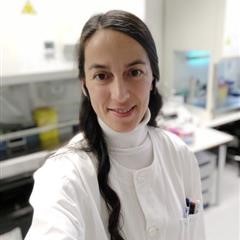
Manuela Rodríguez Vargas
Técnico de Laboratorio


List of staff
Additional Information
Diagnosis/Reference: detection and genotyping of the Human Papillomavirus, tests offered at https://cnm-laboratorios.isciii.es/.
For additional studies contact the laboratory.
• Molecular epidemiology of infections caused by HPV in the general population and in different risk groups.
• Surveillance of the distribution of genotypes in the population to monitor the effectiveness of vaccination against HPV.
• Development of new methodology for the diagnosis and characterization of infections caused by HPV.
Diagnosis/Reference: detection and genotyping of the Human Papillomavirus, tests offered at https://cnm-laboratorios.isciii.es/.
For additional studies contact the laboratory.
• Molecular epidemiology of infections caused by HPV in the general population and in different risk groups.
• Surveillance of the distribution of genotypes in the population to monitor the effectiveness of vaccination against HPV.
• Development of new methodology for the diagnosis and characterization of infections caused by HPV.