



We protect your health through science
Investigation
Molecular characterization of Staphylococcus
Research Lines
Content with Investigacion .
Susceptibilidad del huésped a las infecciones fúngicas invasoras
Se estima que más de un millón y medio de personas mueren al año en el mundo debido a una enfermedad fúngica invasora (EFI). Los tratamientos con inmunosupresores, terapias con corticoides, trasplantes de células hematopoyéticas y órgano sólido así como tratamientos quimioterapéuticos contra el cáncer han favorecido el aumento de estas infecciones fúngicas. El género Aspergillus es la principal causa de EFI por hongos filamentosos, siendo A. fumigatus la especie principalmente aislada en la mayoría de los casos y más frecuentemente asociada a Aspergilosis Invasora.
Muchas de estas infecciones están infra-diagnosticadas debido, tanto a la falta de sospecha clínica como a las limitaciones diagnósticas. Esta línea de investigación tiene como principal objetivo mejorar el pronóstico de la infecciones en pacientes con riesgo de desarrollar infecciones invasoras por hongos. Para ello se estudian marcadores del individuo (denominados biomarcadores del hospedador) que puedan ser detectados de forme temprana en muestras de pacientes en riesgo y que nos permita estratificar a los mismos en función de la susceptibilidad a desarrollar una infección invasora por hongos. Además, estudios realizados en los últimos años muestran que el fondo genético del hospedador está asociado con la predisposición al desarrollo de este tipo de enfermedades. En concreto se han identificado polimorfismos genéticos de nucleótido simple (“Single Nucleotide Polymorphism”- SNP) en genes que codifican para componentes celulares que interaccionan con estructuras fúngicas y/o que están involucradas en la respuesta inmune del huésped frente a agentes infecciosos como Aspergillus. En este sentido se han estandarizado y aplicado herramientas para la detección de SNPs en humanos de genes diana asociados concretamente con la susceptibilidad a la Aspergilosis Invasora.
Estudio de los mecanismos de virulencia en Aspergillus fumigatus
En paralelo al estudio de la respuesta del hospedador se sigue una línea cuyo objetivo es caracterizar mecanismos de virulencia en A. fumigatus. Uno de los principales mecanismos por los que A. fumigatus es capaz de causar enfermedad en humanos es su capacidad de adaptarse a las condiciones ambientales del hospedador. Entre las moléculas y los genes que se han relacionado con la virulencia de este hongo se encuentran componentes de la pared celular, genes y moléculas relacionadas con la evasión de la respuesta inmune, sistemas de detoxificación de los compuestos derivados del oxígeno, la producción de toxinas, la obtención de nutrientes como hierro, fósforo, nitrógeno y la adaptación a pH y temperatura del hospedador. Estos estudios permiten profundizar en el conocimiento sobre la patogenicidad de este hongo e identificar nuevas dianas terapéuticas
Research projects
Content with Investigacion .
Título: Impact of vaccination against Human Papillomavirus in Spain: Studye of the distribution of genotypes and its application in surveillance. Principal Investigator: Horacio Gil. Starting/End dates: 2024-2026. Funding Entity: Acción Estratégica de Salud Intramural (AESI) del Instituto de Salud Carlos III. Project Reference: PI23CIII/00006.
Título: Effect of feminizing therapy on immune response in transgender women. Principal Investigator: Victor Manuel Sánchez Merino. Collaborating Investigator: Horacio Gil. Starting/End dates:2025-2027. Funding Entity: Acción Estratégica de Salud Intramural (AESI) del Instituto de Salud Carlos III. Project Reference: PI24CIII/00031.
Publications
Toll-like receptor signaling-deficient cells enhance antitumor activity of cell-based immunotherapy by increasing tumor homing
A. Morales-Molina, M.A. Rodríguez-Milla, S,. Gambera, T. Cejalvo, B. de Andrés M.L. Gaspar, J. Garcia-Castro. Cancer Res Commun 2023 Mar 1;3(3):347-360. eCollection 2023 Mar
PUBMED DOIImmune stress suppresses innate immune signaling in preleukemic precursor B-cells to provoke leukemia in predisposed mice
Isidro-Hernández M, Casado-García A, Oak N, Alemán-Arteaga S, Ruiz-Corzo B, Martínez-Cano J, Mayado A, G. Sánchez E, Blanco O, Gaspar ML, Orfao A, Alonso-López D, De las Rivas J, Riesco S, Prieto-Matos P, González-Murilo A, García Criado FJ, García Cenador MB, Ramírez-Orellana M, De Andrés B, Vicente-Dueñas C, Cobaleda C, Nichols KE, Sánchez-García I. Nat Commun 2023 Aug 24;14(1):5159.
PUBMED DOIRole of Toll-like receptor 4 in intravascular hemolisis-mediated injury
Vázquez-Carballo C, Herencia C, Guerrero-Hue M, García-Caballero C, Rayego-Mateos S, Morgado-Pascual JL, Opazo-Rios L, González-Guerrero C, Vallejo-Mudarra M, Cortegano I, Gaspar ML, de Andrés B, Egido J, Moreno JA. J Pathol. 2022 Nov; 258(3): 236–249.
PUBMED DOIAge-dependent nasal immune responses in non-hospitalized bronchiolitis children
Cortegano I, Rodríguez M, Hernángómez S, Arrabal A, Garcia-Vao C, Rodríguez J, Sandra Fernández S, Díaz J, de la Rosa B, Solís B, Arribas C, Garrido F, Zaballos A, Roa S, López V, Gaspar ML, de Andrés B. Front Immunol 2022 Dec 6:13:1011607.
PUBMED DOIToll-like receptors in acute kidney injury
Vázquez-Carballo C, Guerrero-Hue M, García Caballero C, Rayego-Mateos S, Opazo-Rios L, Morgado-Pascual JL, Herencia-Bellido C, Vallejo-Mudarra M, Cortegano I, Gaspar ML, de Andrés B, Egido J, Moreno-Gutiérrez JA. Int J Mol Sci. 2021 Jan; 22(2): 816.
PUBMED DOIThe TLR4-MyD88 Signaling Regulates Lung Monocyte Differentiation Pathways in Response to Streptococcus pneumoniae
Sánchez-Tarjuelo R, Cortegano I, Manosalva J, Rodríguez M, Ruiz C, Alía M, Prado MC, Cano EM, Ferrándiz MJ, de la Campa A, Gaspar ML, de Andrés B. Front Immunol 2020 Sep 16:11:2120.
PUBMED DOINrf2 plays a protective role against intravascular hemolysis-mediated acute kidney injury.
Rubio-Navarro A, Vázquez-Carballo C, Guerrero-Hue M, García-Caballero C, Herencia C, Gutierrez E, Yuste C, Sevillano A, Praga M, Egea J, Cannata P, Cortegano I, de Andrés B, Gaspar ML, Cadenas S, Michalska P, León R, Ortiz, A, Egido J, Moreno JA. Front Pharmacol. 2019; 10: 740.
PUBMED DOIPodocytes as new cellular targets of hemoglobin toxicity in massive intravascular hemolysis.
Rubio-Navarro A, Sanchez-Niño MD, Guerrero-Hue M, García-Caballero C, Gutiérrez E, Yuste C, Sevillano A, Praga M, Egea J, Román E, Cannata P, Ortega R, Cortegano I, de Andrés B, Gaspar ML, Cadenas S, Ortiz A, Egido J, Moreno JA. Podocytes as new cellular targets of hemoglobin toxicity in massive intravascular hemolysis. 2018. J.Pathol. 244(3):296-310.
PUBMED DOISpatially-restricted JAG1-Notch signaling in the human thymus provides permissive microenvironments for dendritic cell development.
Martín Gayo, E., González-García, S., García-León, M., Murcia-Ceballos, A., Alcain, J., García-Peydró, M., Allende, L., de Andrés, B., Gaspar, ML. and Toribio, ML. J.Exp.Med. (2017) 214:3361-3379
PUBMED DOIThe formation of titan cells in Cryptococcus neoformans depends on the mouse strain and correlates with induction of Th2-type responses
García-Barbazán, I., Trevijano-Contador, N., Rueda, C., de Andrés, B., Pérez-Tavárez, R., Herrero-Fernández, I., Gaspar ML., and Zaragoza, O. Cellular Microbiology (2015) 18:111-124
PUBMED DOIContent with Investigacion .
-

Horacio Gil Gil
Research Scientist
ORCID code: 0000-0002-7114-6686
Degree in Veterinary Medicine in 1995 and PhD in Veterinary Medicine in 2002 from the University of Zaragoza. He did his PhD thesis at NEIKER Tecknalia (Derio, Vizcaya) and the National Center for Microbiology of Instituto de Salud Carlos III (CNM-ISCIII, Majadahonda, Madrid) on the biological cycle of Lyme disease in the Basque Country. After that, he developed his postdoctoral training in different aspects of the pathogenesis of tularemia at the Center for Infectious Diseases, Stony Brook University, New York (USA) for 3 years. In December 2005, he joined the Reference and Research Laboratory in Special Pathogens of the CNM-ISCIII where he developed diagnostic, reference and research activities, in Bartonella, Leptospira and pathogens of interest in bioterrorism. Between 2014-2016 he participated in the European Program for the Training of Microbiologists in Public Health (EUPHEM), organized by the European Centre for Disease Prevention and Control. During this program, he participated in an international mission for the investigation of a cholera outbreak in Ghana, proposed by the Bernhard Nocht Institute for Tropical Diseases in Hamburg (Germany). In December 2016, he worked as a laboratory consultant for the World Health Organization at their office in Phnom Penh (Cambodia). Subsequently, he worked one year with Médecins Sans Frontières as director and quality manager of the TB laboratory in Nukus (Uzbekistan).
In 2019, he joined the HIV Variability and Biology Unit at CNM-ISCIII, where he developed different reference and research activities, including his contribution to the molecular epidemiological surveillance of HIV-1 in Spain and the study of HIV-1 antiretroviral resistance. Since September 2022 he has been leading the Human Papillomavirus Unit at the CNM-ISCIII. -
Alicia Inés García Señán
Predoctoral Student UNED
Degree in Pharmacy in 2013 from the Complutense University of Madrid. She completed specialized health training in Microbiology and Parasitology at the Complejo Asistencial Universitario de Salamanca (2014-2018). During this period he studied a master's degree in Tropical Diseases at the University of Salamanca (2016). She has developed her professional activity as a clinical microbiologist at the Hospital de Santa Bárbara (Soria) (2018), Hospital Universitario Vall d'Hebrón (Barcelona) (2019-2022), and Hospital Central de la Defensa (Gómez Ulla) C.S.V.E, since 2022. In September 2024 she has started PhD studies at the Human Papillomavirus Unit of the CNM-ISCIII.
-
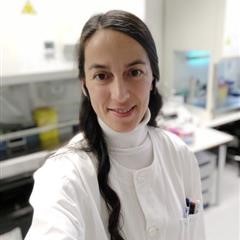
Manuela Rodríguez Vargas
Técnico de Laboratorio


List of staff